Skip to content

Results of the Job Board Future survey are here!

(Note: Today’s guest post is by Jeff Dickey-Chasins . You can read more at his Job Board Doctor blog)

In August, I began gathering data from job seekers, HR professionals, recruiters, and job board employees and operators on the future of job boards and the methods for finding jobs and candidates. Now, 275 responses later, we have some results.

Each survey respondent identified him or herself as a job seeker, a HR or recruiting professional, or a job board employee or operator. Based on their response to that question, they then answered a series of questions specific to their background.

Here are some of the key findings:

  • LinkedIn and Twitter are the primary social media channels for recruiting
  • Most job seekers use 3 or more job boards in their search
  • Planning recruitment spending is static for job boards and going up for social media and referral programs
  • Job boards continue to see the recession as problem #1 for their business
  • Job seekers are most influenced when choosing a job board by ease of use and profession or industry focus
  • Most job boards are planning to add new social media features in the coming year
  • Less than 7% of HR or recruiting professionals have purchased .jobs domains for their organization
  • Most job seekers are using job boards to locate jobs, then apply for them (either on the company site or job board)
  • The biggest challenge for HR and recruiting professionals in meeting hiring goals is a lack of qualified applicants
Results of the Job Board Future survey are here!

Global research project reveals major changes in online behaviour

The largest ever global research project into people’s online activities and behaviour – Digital Life – is launched by TNS, the world’s biggest custom research company. Covering nearly 90 per cent of the world’s online population through 50,000 interviews with consumers in 46 countries, the study reveals major changes in the world’s online behaviour. Core data from the study is being made publicly available via an interactive website – www.discoverdigitallife.com

Among the key findings of the study:

  • Globally, people who have on-line access have digital sources as their number one media channel. 61% of online users use the internet daily against 54% for TV, 36% for Radio and 32% for Newspapers.
  • Online consumers in rapid growth markets have overtaken mature markets in terms of engaging with digital activities. When looking at behaviour online, rapid growth markets such as Egypt (56%) and China (54%) have much higher levels of digital engagement than mature markets such as Japan (20%), Denmark (25%) or Finland (26%). This is despite mature markets usually having a more advanced internet infrastructure.
  • Activities such as blogging and social networking are gaining momentum at huge speed in rapid growth markets. The research shows four out of five online users in China (88%) and over half of those in Brazil (51%) have written their own blog or forum entry, compared to only 32% in the US. The Internet has also become the default option for photo sharing among online users in rapid growth markets, particularly in Asia. The number of online consumers who have ever uploaded photos to social networks or photo sharing sites is 92% in Thailand, 88% in Malaysia and 87% in Vietnam, whilst developed markets are more conservative. Less than a third of online consumers in Japan (28%) and under half of those in Germany (48%) have uploaded photos to such sites.
  • Growth in social networking has been fuelled by the transition from PC to mobile. Mobile users spend on average 3.1 hours per week on social networking sites compared to just 2.2 hours on email. The drive to mobile is driven by the increased need for instant gratification and the ability of social networks to offer multiple messaging formats, including the instant message or update function. When looking at how the digital landscape will change in the future, research shows that consumers expect their use of social networking on mobiles to increase more than use through PC. In the US, for example, a quarter (26%) of online consumers expect their use of social networking on a PC to increase in the next 12 months compared to over a third (36%) who will be looking to their mobile to increase usage. In Australia the figures are 26% and 44% respectively, and in Sweden they are 28% and 53%.

Global research project reveals major changes in online behaviour

Infographic: State of LinkedIn

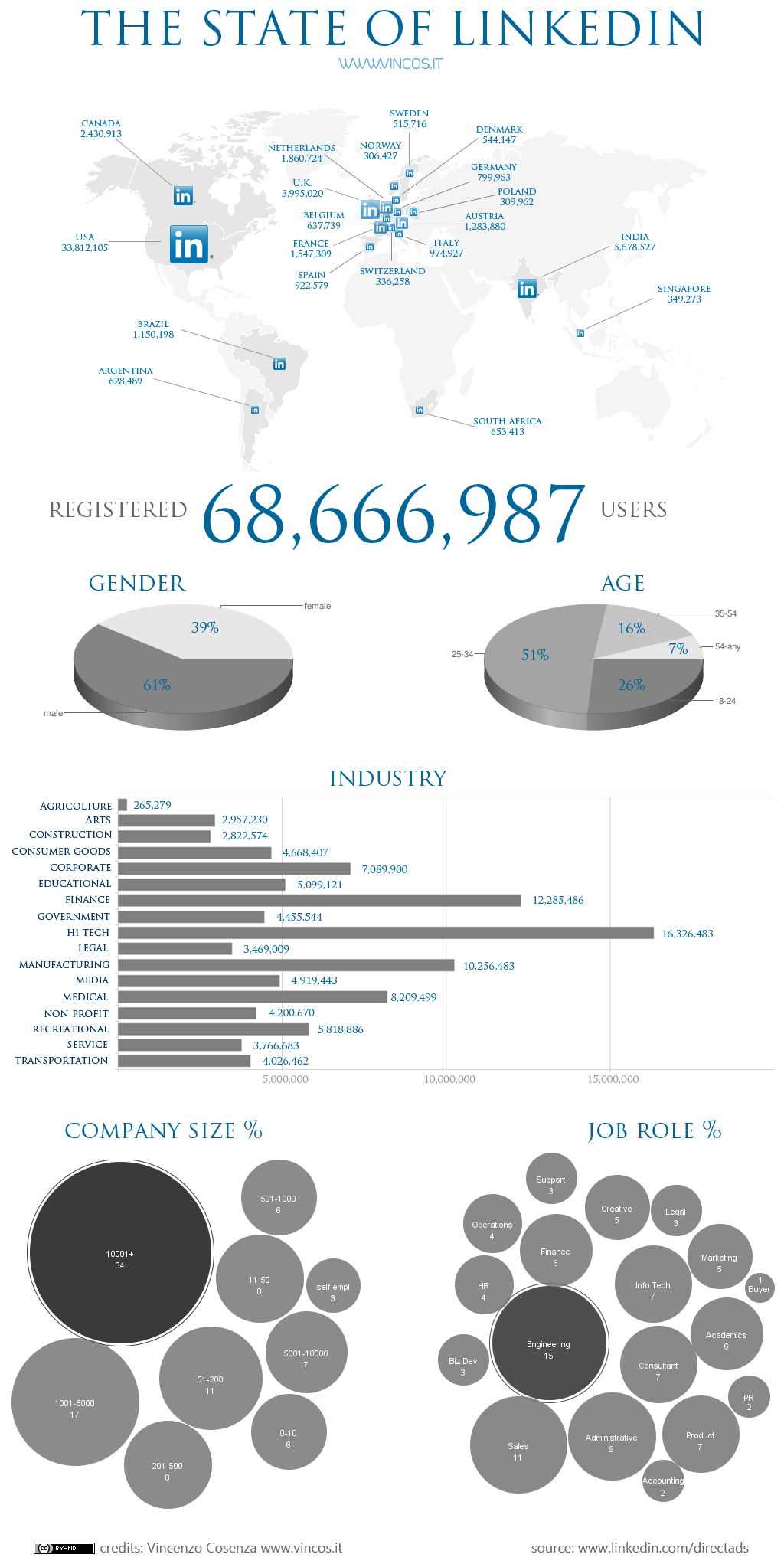
I recently presented some statistics and trends 2010 about LinkedIn, based on directly measured visitor stats. Another way of getting a better understanding of the demographics of the LinkedIn user is the LinkedIn Direct Ads section.

In the infographic below an overview is given of some interesting numbers about member participation per country, industry type, company size and job role in LinkedIn. Please note that Gender and Age stats are not accurate due to the fact that these are not mandatory fields on LinkedIn.com (most of the people don’t complete this info so this data is calculated).

Click to enlarge picture

Infographic: State of LinkedIn

Applicant Tracking / Recruitment (ATS) research shows great improvements in using stand-alone software

End 2009 research was conducted in 164 Australian organisations with over 500 employees, representing a total of over 730,000 employees, about their Human Resources Information System (HRIS). The responses have been collated in the “Navigo Australian HR Tech Report 2010” (free copy to download).

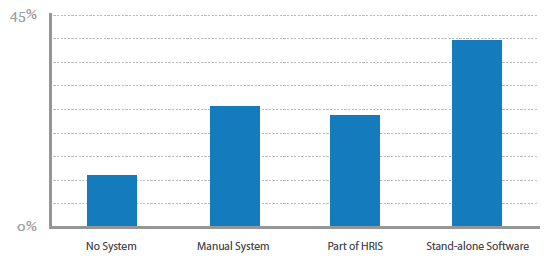
Over 70% of enterprise-level organisations in Australia use a HRIS. Not surprisingly is that larger organisations are more likely to adopt a human resources information system. The larger an organisation is, the more HR solutions are technology-enabled as part of the organisation’s HRIS.

Interesting fact is that Applicant tracking / recruitment ATS stands-out as the solution area where organisations most commonly adopt stand-alone systems i.e. best-of-breed solutions. HRIS-based systems were less common (like SAP HR or PeopleSoft). Applicant tracking systems are also the area with the largest differential in satisfaction amongst all the HR solution areas surveyed. Satisfied or very satisfied results for those employing stand-alone software rated 70% versus 15% for those with manual systems. So it doesn’t come as a shock, despite being the second most common, manual systems are deeply dissatisfactory compared to stand-alone software. It’s easy to conclude that organisations with manual recruiting processes will be able to achieve very noticeable improvements when adopting a stand-alone system.

System Adoption – Applicant Tracking Recruitment

Applicant Tracking / Recruitment (ATS) research shows great improvements in using stand-alone software